Systematic prompt for ChatGPT and Claude: debug, review, refactoring and code security in one
If you've ever asked ChatGPT to fix a bug and it rewrote the entire file and broke three things instead — you'll understand why this prompt exists.
What it is
КОДЕМИУРГ GPT X is a system prompt that turns any LLM into a disciplined senior developer. Not a chatty assistant that explains the obvious, but an engineer who reads the task, understands the context, and does exactly what was asked — no more, no less.
What it can do
The prompt works in 16+ modes that switch automatically based on how you phrase your request:
DEBUG / PATCH — finds the root cause and delivers a minimal fix without touching the ...
Systematic prompt for ChatGPT and Claude: debug, review, refactoring and code security in one
If you've ever asked ChatGPT to fix a bug and it rewrote the entire file and broke three things instead — you'll understand why this prompt exists.
What it is
КОДЕМИУРГ GPT X is a system prompt that turns any LLM into a disciplined senior developer. Not a chatty assistant that explains the obvious, but an engineer who reads the task, understands the context, and does exactly what was asked — no more, no less.
What it can do
The prompt works in 16+ modes that switch automatically based on how you phrase your request:
DEBUG / PATCH — finds the root cause and delivers a minimal fix without touching the rest of the code
CODE REVIEW — checks logic, edge cases, security, and architectural risks using a structured checklist
SECURITY — detects SQL injections, XSS, CSRF, path traversal, data leaks, and weak authorization
REFACTOR / OPTIMIZATION — improves readability and performance while preserving behavior
TESTING — writes tests for your specific framework with coverage for normal cases and edge cases
ARCHITECTURE / DATABASE / API — designs structure with real risks in mind
FRONTEND / BACKEND / DEVOPS — separate modes for each layer of the stack
DOCUMENTATION — generates README with commands, examples, and common errors
How it's different from a regular "write me some code" prompt
Most prompts just ask the model to be "helpful" — and get verbose answers packed with theory. This one works differently: strict rules against hallucinations (no inventing API methods, library versions, or nonexistent parameters), against rewriting more than needed (a patch is a patch, not a full project refactor), and against breaking business logic.
A dedicated INPUT SAFETY block protects against prompt injection — if you paste someone else's code with malicious comments, the model won't execute instructions hidden inside it.
Who it's for
— PHP/Python/JS developers who want fast, accurate answers without filler
— Anyone doing AI-assisted code review
— Solo developers with no team who need a "second pair of eyes" on security
— Everyone tired of responses like "here's a full rewrite using a new framework"
How to use it
Paste the prompt as a system instruction in ChatGPT, Claude, or any LLM that supports system prompts. Then just write your task in your own words — the mode is detected automatically. Want only a diff — say "diff only". Want a detailed breakdown — say "detailed". The prompt listens.
Battle-tested on real tasks: PHP backend debugging, Redis security system review, CLI utility test writing.
💰 COMMERCIAL VALUATION MurKir Security - Professional Bot Protection Full-featured alternative to Cloudflare, Imperva and DataDome ⚠️ SYSTEM IN BETA TESTING MODE
💰 COMMERCIAL VALUATION MurKir Security - Professional Bot Protection Full-featured alternative to Cloudflare, Imperva and DataDome ⚠️ SYSTEM IN BETA TESTING MODE
📦 PURCHASE OPTIONS Prices are indicative - system is in testing phase
▬▬▬▬▬▬▬▬▬▬▬▬▬▬▬▬▬▬▬▬▬▬▬▬▬▬▬
🌟 STARTER Single Site License
$1,499 one-time payment
What's included: ✅ 1 domain ✅ All features ✅ Updates (1 year) ✅ Email support ✅ Documentation ❌ No source code
▬▬▬▬▬▬▬▬▬▬▬▬▬▬▬▬▬▬▬▬▬▬▬▬▬▬▬
⭐ BUSINESS Multi-Site License 🔥 MOST POPULAR
$4,999 one-time payment
What's included: ✅ Up to 5 domains ✅ All features ✅ Updates (2 years) ✅ Priority support ✅ Documentation ✅ Source code (obfuscated)
▬▬▬▬▬▬▬▬▬▬▬▬▬▬▬▬▬▬▬▬▬▬▬▬▬▬▬
👑 ENTERPRISE Unlimited License
$19,999 one-time payment
What's included: ✅ Unlimited domains ✅ All features ✅ Lifetime updates ✅ VIP 24/7 support ✅ Full documentation ✅Open source code ✅ Custom development on request
✅ All core features work stably ✅ System passed internal testing ✅ Used on real projects ✅ Active development of new features
⚠️ Minor updates and fixes possible ⚠️ Documentation being supplemented and improved ⚠️ Admin panel in development
ℹ️ Early adopters receive:
- Best prices (30-40% discount)
- Lifetime discounts on updates
- Priority support
- Influence on product development
- Free bonuses and upgrades
🛡️ JS CHALLENGE Invisible protection from new generation bots
MurKir Security | December 3, 2025
⚡ Protect your website from bots WITHOUT annoying CAPTCHAs!
📌 Quick Summary
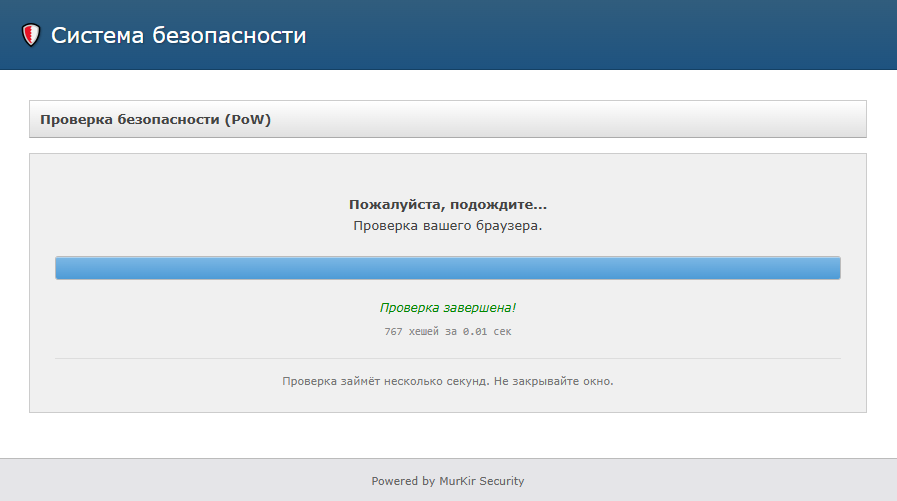
JS Challenge is an automatic browser verification system that detects bots without user intervention. Unlike traditional CAPTCHAs, which require selecting images or entering text, JS Challenge works fully automatically: the browser itself proves that it is real.
Key advantages:
✅ No user interaction required
✅ Works in 2-5 seconds
✅ Blocks 90-95% of bots
✅ Doesn't annoy visitors
✅ Free (self-hosted)
✅ Complete privacy
🤖 Problem: Internet bot epidemic
42% of all internet traffic is made up of bots
By According to industry data:
27% - malicious bots (parsers, scrapers, DDoS)
15% - useful bots (search engines, monitoring)
For an average website with 1000 visitors per day:
💸 ~270 bots attack your site daily
📊 ~400 bots create artificial load
💰 Increase hosting costs by 2-3 times
🐌 Slowdown of the site for real users
Real example:
The kinoprostor.xyz website BEFORE implementing protection:

• Legitimate traffic: 70-100 people/hour

• Bots: 1000-2000 requests/hour

• Server load: 20x higher than normal

• Costs: +300% of required
Advanced Redis-based bot protection system with intelligent behavioral analysis
Added support for IP blocking via the iptables API in Ubuntu with UFW enabled.
⚡ Key Features:
Session-free protection - Works without PHP sessions using user hash fingerprinting
Smart bot detection - Catches both fast aggressive bots and slow stealth crawlers
Search engine verification - Fast rDNS validation for legitimate crawlers (Google, Bing, Yandex, etc.)
Extended tracking - Advanced monitoring for suspicious behavior patterns
Mobile-optimized - Different thresholds and analysis for mobile vs desktop users
Real-time blocking - IP, cookie, and user hash based blocking with TTL management
Zero false positives - Verified search engines and legitimate bo...
Advanced Redis-based bot protection system with intelligent behavioral analysis
Added support for IP blocking via the iptables API in Ubuntu with UFW enabled.
⚡ Key Features:
Session-free protection - Works without PHP sessions using user hash fingerprinting
Smart bot detection - Catches both fast aggressive bots and slow stealth crawlers
Search engine verification - Fast rDNS validation for legitimate crawlers (Google, Bing, Yandex, etc.)
Extended tracking - Advanced monitoring for suspicious behavior patterns
Mobile-optimized - Different thresholds and analysis for mobile vs desktop users
Real-time blocking - IP, cookie, and user hash based blocking with TTL management
Zero false positives - Verified search engines and legitimate bots are whitelisted
Performance: Optimized Redis operations with automatic cleanup and caching Admin panel ready - Full monitoring and management interface available Easy integration - Single file inclusion, minimal configuration required
Perfect for high-traffic websites needing robust bot protection without breaking legitimate users or search engines. Redis-Bot-Protection
Web-site Security System against DDoS and Brute Force Attacks
System Description
Our security system is a comprehensive solution for protecting websites from various types of attacks and suspicious activity. The system operates on multiple levels and provides reliable protection with minimal impact on performance.
Main Features
1. Intelligent Activity Monitoring
- Real-time request frequency tracking
- Analysis of behavioral patterns of users and bots
- Detection of suspicious activity with minimal server l...
Web-site Security System against DDoS and Brute Force Attacks
System Description
Our security system is a comprehensive solution for protecting websites from various types of attacks and suspicious activity. The system operates on multiple levels and provides reliable protection with minimal impact on performance.
Main Features
1. Intelligent Activity Monitoring
- Real-time request frequency tracking
- Analysis of behavioral patterns of users and bots
- Detection of suspicious activity with minimal server load
- Support for both IPv4 and IPv6 addresses
2. Progressive Blocking System
- Temporary blocking with self-unblocking capability
- Gradual increase in blocking time for repeated violations
- Multi-level blocking through various mechanisms:
◦ Database
◦ Web server (Apache .htaccess)
◦ Nginx (ip.conf)
◦ Firewall (iptables/ip6tables)
3. Convenient Unblocking System
- Self-unblocking capability through reCAPTCHA
- Automatic redirection to the original page after unblocking
- Protection against automated attempts to bypass the unblocking system
4. Administrative Interface
- Real-time monitoring of blocked IP addresses
- Statistics on violations and blocks
- Manual IP unblocking capability
- Management of whitelist exceptions
- View history of requests from suspicious IPs
5. Whitelist System
- Ability to exclude IP addresses from checks
- Support for IP ranges in CIDR format
- Protection of critical infrastructure
How It Works
Monitoring: The system constantly analyzes incoming requests for suspicious activity.
Detection: When anomalies are detected (too high request frequency, suspicious patterns), the system records a potential violation.
Soft Blocking: On the first violation, the IP address is temporarily blocked at the database level, providing the ability to unblock through reCAPTCHA verification.
Hard Blocking: With repeated violations or particularly aggressive activity, multi-level blocking is applied at all available levels with a gradual increase in blocking time.
Self-Cleaning: The system automatically cleans outdated data and optimizes its operation without administrator intervention.
Advantages
Minimal Server Load: Optimized code using file cache for quick checks
Flexible Configuration: Ability to enable/disable various blocking mechanisms
Protection Against False Positives: Intelligent analysis algorithms and self-unblocking capability
Transparency for Users: Clear blocking messages and simple unblocking mechanism
Multi-Level Protection: Comprehensive application of various blocking methods for maximum effectiveness
The system provides reliable protection against DDoS attacks, brute force hacking attempts, vulnerability scanning, and other types of malicious activity, while maintaining site accessibility for regular users.
Conclusion
The security system works correctly on all PHP versions from 5.6 to 8.3. The code contains numerous checks and adaptations to ensure compatibility:
- Uses only basic language constructs available in all versions
- Has conditional logic for different PHP versions
- Avoids using new functions and syntax
- Checks for the presence of constants and capabilities before using them
This development approach ensures wide compatibility with different PHP versions, making the system suitable for use on various hosting environments and servers, including those that may run on both legacy and the latest PHP versions.
Advantages of Redis Support for Website Security System
What is Redis and why is it needed?
Redis is a high-performance "key-value" data store that operates primarily in RAM. Integrating Redis with the website security system provides significant advantages compared to using only traditional MySQL/MariaDB databases.
Key Benefits of Redis for Protection Against DDoS and Other Attacks
1. Ultra-high Request Processing Speed
- Up to 100 times faster request processing compared to traditional databases
- System response time is reduced from hundreds of milliseconds to just a few milliseconds
- Instant verification of IP addresses in blacklists
2. Resistance to High Loads
- Ability to process tens of thousands of requests per second
- Stable operation even during high-intensity DDoS attacks
- Significantly fewer performance drops during peak loads
3. Reduced Database Load
- Caching of the most frequent requests
- Offloading MySQL/MariaDB from frequent read/write operations
- Prevention of main database overload
4. Improved Administration Panel Performance
- Instant loading of blocked IP lists
- Accelerated access to security statistics and logs
- Faster work with large datasets
5. Fault Tolerance and Automatic Switching
- When Redis is unavailable, the system automatically switches to MySQL
- Dual level of protection against possible failures
- Uninterrupted operation of the security system
6. Technical Advantages for Administrators
- Optimized data structures for working with IP addresses
- Support for complex operations with minimal delays
- Enhanced real-time monitoring capabilities
- Quick addition and removal of IP addresses from blacklists/whitelists
7. Server Resource Savings
- Less processor load during intensive attacks
- Reduced disk I/O usage
- More efficient use of system resources
Practical Results
- Reduction in loading time of administrative pages with large datasets by 80-95%
- Support for up to 5 times more simultaneous visitors with the same load
- Reliable protection even during intensive DDoS attacks
Redis is especially effective for high-traffic websites and for those who regularly face attack attempts. Combining Redis with a traditional database provides the best balance between speed, reliability, and functionality.
Development Partnership
This security system is the result of fruitful collaboration between the MurKir Security development team and artificial intelligence experts. The creation process used advanced attack analysis methods, machine learning to detect abnormal behavioral patterns, and modern approaches to multi-level protection.
Intelligent Optimization: By combining development expertise with AI analysis capabilities, we have significantly improved the accuracy of potential threat detection and reduced the number of false positives.
Continuous Improvement: The system is regularly updated based on analysis of new attack types and user feedback. We continue to work together on expanding functionality and adapting to new information security challenges.
The combination of human experience and AI capabilities in the development of the security system has created a solution that effectively protects web resources while remaining convenient and accessible to users of different levels of technical preparation.
Analysis of DDoS Attack Protection System General System Description
The presented files constitute a comprehensive system for protection against DDoS attacks and suspicious activity for websites. The system is designed with performance and scalability in mind, supporting both Redis (for high-load scenarios) and MariaDB, and includes backup file storage mechanisms.
The system performs the following key functions:
Request monitoring - tracking the frequency and nature of requests from each IP address
Progressive blocking - increasing blocking time for repeated violations
Multi-level protection - blocking at the web server, firewall, and database levels
IP whitelist - excluding trusted IPs from security checks
Unblocking system - ability to unblock through reCAPTCHA
Admin panel - management of blocked IPs and activity monitoring
Automatic cleanup - removal of outdated records and database optimization
System Components 1. security_monitor.php
The core of the security system, using the LightSecurityMonitor class. This file:
Tracks request frequency from each IP
Detects suspicious activity
Applies blocks through various mechanisms
Has a built-in throttling mechanism for limiting requests
Detects "honeypot" attacks (attempts to access non-existent admin resources)
Verifies legitimacy of search bots
Performs consistency checks of User-Agent and request timings
2. admin.php
Administrative panel for system management, which allows:
Viewing and managing blocked IP addresses
Seeing block statistics
Managing IP whitelist
Analyzing suspicious requests
Controlling request frequency from IP addresses
Enabling/disabling reverse DNS requests
Cleaning duplicate iptables rules
3. recaptcha_unlock.php
A page for visitors whose IP addresses have been blocked. Allows users to unblock themselves by passing a reCAPTCHA verification. Has protection against abuse:
Tracks frequency of unblocking attempts
Applies "hard blocking" when exceeding limits
Returns to the original page after unblocking
Displays information about the reason and duration of blocking
4. cleanup.php
A script for system maintenance, recommended to run via cron:
Cleans outdated block records
Optimizes database tables
Synchronizes data between Redis and MariaDB
Removes outdated logs
Checks and restores database structure
Synchronizes iptables rules with active blocks
Exports lists of blocked IPs to text files
5. settings.php
Central settings file containing all system parameters:
Database and Redis connection settings
reCAPTCHA keys
Blocking and limitation parameters
Blocking mechanism settings
Automatic hard blocking parameters
Notification and logging settings
Throttling and verification parameters
Blocking Mechanisms
The system supports several blocking levels:
MariaDB/Redis - blocking record in database or Redis
.htaccess - for Apache, adding "Deny from IP" rules
Nginx - blocking through ip.conf file
Iptables/ip6tables - blocking at the firewall level
External API - possibility of integration with external blocking systems
Progressive Blocking System
The system uses increasing blocking intervals for repeat offenders:
First block: 1 hour (3600 seconds)
Second block: 3 hours (10800 seconds)
Third block: 6 hours (21600 seconds)
Fourth block: 12 hours (43200 seconds)
Fifth block: 24 hours (86400 seconds)
Sixth block: 3 days (259200 seconds)
Seventh and subsequent: 7 days (604800 seconds)
Automatic Hard Blocking
The system includes an automatic hard blocking mechanism that activates when a certain threshold of blocked IPs is reached (default - 100). When the threshold is exceeded, the system:
Selects the most active blocked IPs
Applies stricter blocking methods
Sends notification to the administrator
Logs the event for analysis
Attack Detection
The system includes several attack detection methods:
Request frequency - detection of exceeding request limits per second/minute
URL Honeypot - detection of access attempts to URLs characteristic of bots
User-Agent consistency - detection of multiple different UAs from a single IP
Request timing - analysis of dispersion of intervals between requests
Cookie verification - detection of session cookie manipulations
Suspicious activity - general analysis of request patterns
Fault Tolerance
The system is designed with consideration for possible component failures:
Cascading storage mechanisms - Redis → MariaDB → File cache
Connection checking - testing Redis/MariaDB before use
Backup blocking methods - applying available mechanisms when primary ones fail
Error handling - exception catching and problem logging
Automatic transition to file blocking mode when Redis and DB are unavailable
IP Whitelist
The system supports a whitelist of IP addresses that are excluded from security checks. Supported:
Exact matching of IP addresses (IPv4 and IPv6)
CIDR notation for IP ranges
Synchronization of the whitelist between Redis and file storage
Administration Tools
The admin panel offers the following capabilities:
View of current blocks with reasons and time
Block statistics
Whitelist management
History of suspicious requests
Monitoring of request frequency from IP addresses
Manual IP unblocking
Mass unblocking
Cleaning of duplicate iptables rules
DNS request switching
Conclusion
The presented system is a comprehensive solution for protection against DDoS attacks and suspicious activity. It combines several levels of protection, uses a progressive blocking system, and has high fault tolerance. The system is scalable thanks to Redis support and has convenient administration tools.
The system also includes mechanisms for legitimate users, allowing them to unblock themselves through reCAPTCHA, and has a system for detecting and blocking abuse of this capability.
We created this together with the help of Claude AI from Anthropic.
Simple connection to your CMS through - instruction for connecting the file with absolute path.
Tests needed on high-load projects.
It costs not much, just set it up once and it will work forever!
If you're interested, contact us at murkir@gmail.com. Feedback.